


Understanding cryptocurrency in the modern economy
Cryptocurrency is a digital asset that has transformed how people think about money and value exchange. In simple terms, cryptocurrency is a form of electronic currency, created and stored digitally, which uses cryptographic techniques and a decentralised ledger—known as blockchain—to verify transactions.
This article explores what cryptocurrency is, how cryptocurrency works, the benefits and risks (including scams and money laundering), whether cryptocurrency is predictable, and how large the cryptocurrency economy is today.


What exactly is cryptocurrency and how does it work
At its core, cryptocurrency is a type of digital asset that relies on blockchain technology. A blockchain is a distributed ledger maintained across a peer-to-peer network of computers and records each transaction in a block that links to previous ones.
Here’s how cryptocurrency works:
- A user initiates a transaction using cryptographic keys.
- The transaction is broadcast to the network for validation.
- Nodes verify it, ensuring sufficient funds and valid digital signatures.
- Confirmed transactions are added into a new block.
- The block links to the previous one, forming a tamper-resistant chain.
This decentralised system removes the need for a central authority or bank. It’s a peer-to-peer financial ecosystem secured by code rather than trust.
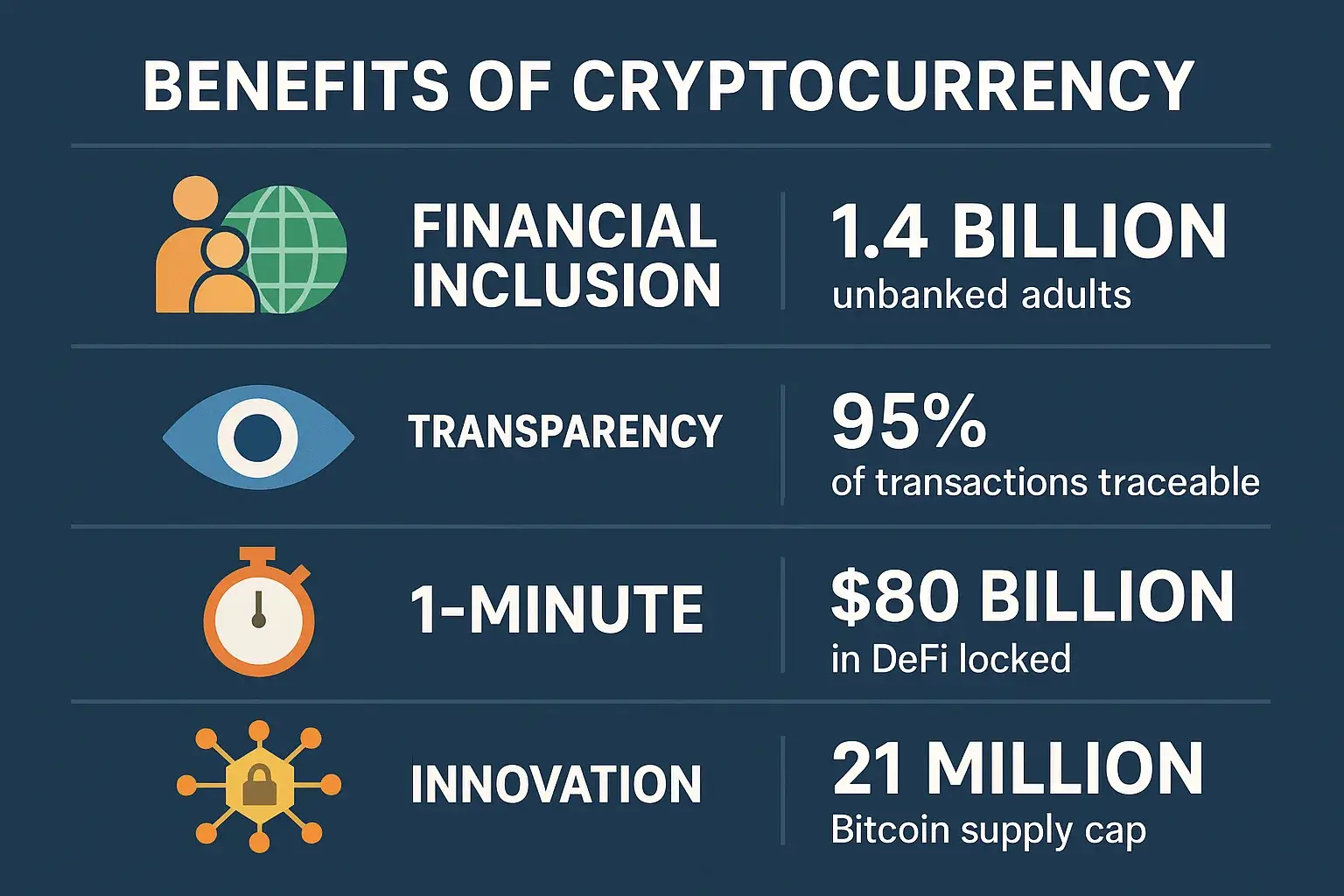
The benefits of cryptocurrency
Cryptocurrency provides both financial and technological advantages that continue to drive global adoption.
1. Financial inclusion
Over 1.4 billion adults worldwide remain unbanked, yet many have mobile access. Cryptocurrency provides these users with access to financial tools without needing a traditional bank.
2. Transparency and security
More than 95% of blockchain transactions are publicly traceable, meaning they can be audited in real time. Cryptography ensures that records cannot be altered once added to the blockchain.
3. Speed and efficiency
Global crypto transactions can settle in seconds to minutes, compared to traditional cross-border payments which often take 1–5 business days.
4. Smart contracts and innovation
Over $80 billion is currently locked in decentralised finance (DeFi) protocols, showing rapid innovation across programmable finance.
5. Limited supply and inflation hedge
Bitcoin’s maximum supply is capped at 21 million coins, reinforcing its scarcity and appeal as a potential hedge against fiat currency inflation.
How cryptocurrency is used for scams and money laundering
While cryptocurrency has legitimate uses, it’s also exploited for illicit activities.
Crypto scams
Fraud remains a persistent problem:
- More than $14 billion in crypto was lost to scams and theft in 2023, according to multiple blockchain analytics firms.
- Common scams include fake investment platforms, “pig-butchering” relationship scams, and impersonation of influencers or exchanges.
- Rug pulls—where developers abandon projects after taking investor funds—accounted for roughly 37% of crypto losses in recent years.
Money laundering through cryptocurrency
Criminals exploit blockchain anonymity using:
- Mixers/tumblers that obscure fund origins.
- Layering—splitting funds across multiple wallets.
- Cross-chain swaps and conversion to privacy coins.
Regulatory agencies estimate that around 0.24% of total crypto activity involves illicit transactions—still billions of dollars, but proportionally small compared with the legitimate volume.

Is cryptocurrency predictable?
Cryptocurrency markets are highly volatile and difficult to forecast.
- Bitcoin, the largest cryptocurrency, has seen daily price swings of over 10% multiple times per year.
- Regulatory announcements, technological upgrades, or social media sentiment can shift market value dramatically within hours.
- Over 20,000 active cryptocurrencies now trade globally, each influenced by different tokenomics and investor behaviour.
While on-chain analytics and AI models attempt to predict movements, most experts agree that cryptocurrencies remain largely unpredictable, driven by emotion and speculation as much as data.
How much is in the economy of cryptocurrency today?
As of late 2025, the total global cryptocurrency market capitalisation is estimated at US $3.8 – 3.9 trillion, making it comparable in size to major national economies.
- Bitcoin accounts for roughly 48% of total market value, while Ethereum contributes about 18%.
- Over 700 million people globally now own some form of cryptocurrency wallet.
- Daily trading volume exceeds US $150 billion, with thousands of exchanges operating worldwide.
This demonstrates the scale of crypto’s economic footprint and its growing relevance to global finance.
The reality of cryptocurrency
Cryptocurrency is a digital asset powered by blockchain technology. It enables secure, borderless transactions and financial inclusion, yet it also carries risks—volatility, scams, and misuse for money laundering.
Today’s cryptocurrency economy exceeds US $3.8 trillion and continues to expand as adoption widens. However, predictability remains elusive, making caution and education essential for anyone entering this dynamic financial landscape.
See our other article – The Global Economy in 2025: The Hidden Forces Shaping Growth
Questions & Answers
Q1: What is cryptocurrency?
Cryptocurrency is a digital form of money that operates on blockchain technology, allowing secure peer-to-peer transactions without banks.
Q2: How is cryptocurrency used for money laundering?
Criminals use mixers, layering, and cross-chain swaps to obscure illicit funds before cashing out through exchanges.
Q3: Can cryptocurrency prices be predicted?
Not reliably. Extreme volatility and market sentiment make short-term forecasts highly uncertain.
Q4: How large is the cryptocurrency economy?
As of 2025, the market is worth between US $3.8 – 3.9 trillion, with hundreds of millions of global users.