

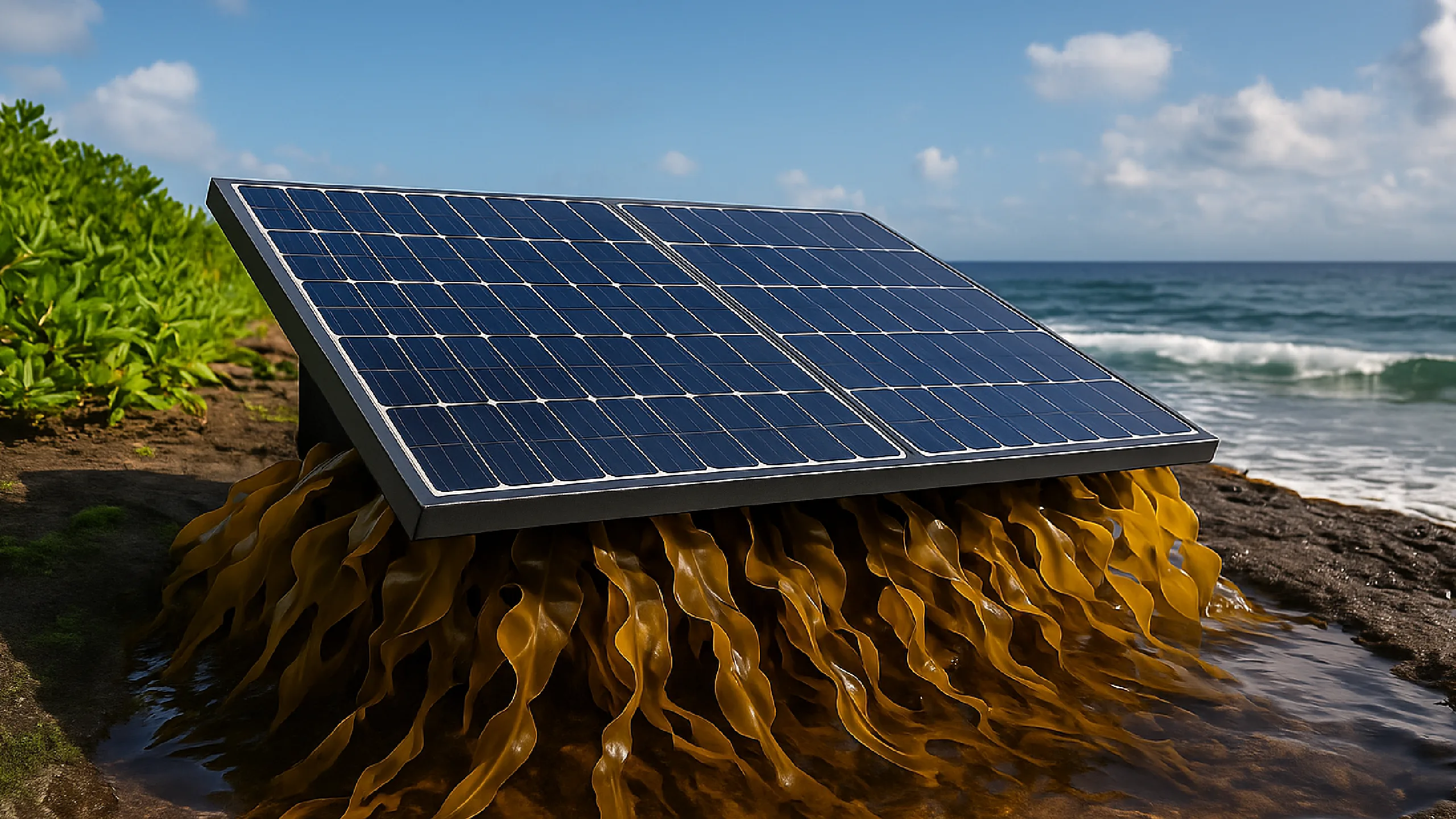
How Seaweed Sparks Innovation in Solar Technology
Seaweed solar design is revolutionising how researchers approach sustainable energy by mimicking the light-absorbing strategies and light-scattering surfaces found in seaweed cell structures. In the first 100 words, we explore how seaweed’s natural optimization of capturing light and scattering photons can lead to biomimicry solar panels that are more efficient, less costly, and more durable. By studying algae-inspired solar technology, engineers hope to design solar panels that perform better in low light or diffuse sunlight, reduce material waste, and lower production costs.
Seaweed Cell Structures & Their Light Capture Tricks
Seaweed, like kelp or red algae, has evolved complex internal microstructures to optimise light absorption. Key features include:


- Pigment layers with chloroplasts that capture a broad spectrum of light. These layers allow seaweed to absorb red, blue, and green wavelengths efficiently.
- Scattering matrices – microscopic air spaces or structural folds within cells scatter incoming light, extending the light path and increasing photon capture.
- Gradual refractive index changes between cellular walls and internal organelles – these reduce reflection losses and trap more light inside.
These light-absorbing strategies and light-scattering surfaces in seaweed cell structures can inspire solar panel materials to mimic similar internal architectures. Using nanostructured films or bio-composite layers, solar designers can emulate seaweed solar design principles to increase absorption without adding expensive rare materials.
Translating Seaweed Solar Design into Material Innovation
How might engineers implement seaweed solar design in real solar panels? Here are a few promising approaches:
- Nanostructured coatings
Mimicking seaweed’s scattering surfaces, coatings with micro- or nano-scale ridges can increase the path length of incoming light, reducing losses. These coatings can be added to thin-film solar cells or flexible photovoltaic sheets. - Biohybrid composites
Integrating seaweed-derived biopolymers, algae-extracted pigments, or marine bioinspired materials into solar cell layers. This not only helps with light absorption but may reduce cost and environmental impact. - Graded refractive index layers
Just as seaweed has smooth transitions between different internal tissues, solar panels can have engineered refractive index gradients to minimize reflection—leading to better low-light performance and efficiency. - 3D structural mimicry
More complex designs inspired by seaweed fronds or filaments: solar panels with internal microchannels or scaffold structures that diffuse and distribute light, much like seaweed does, especially in murky or deep water.
Benefits & Challenges of Seaweed-Inspired Biomimicry Solar Panels
Benefits:
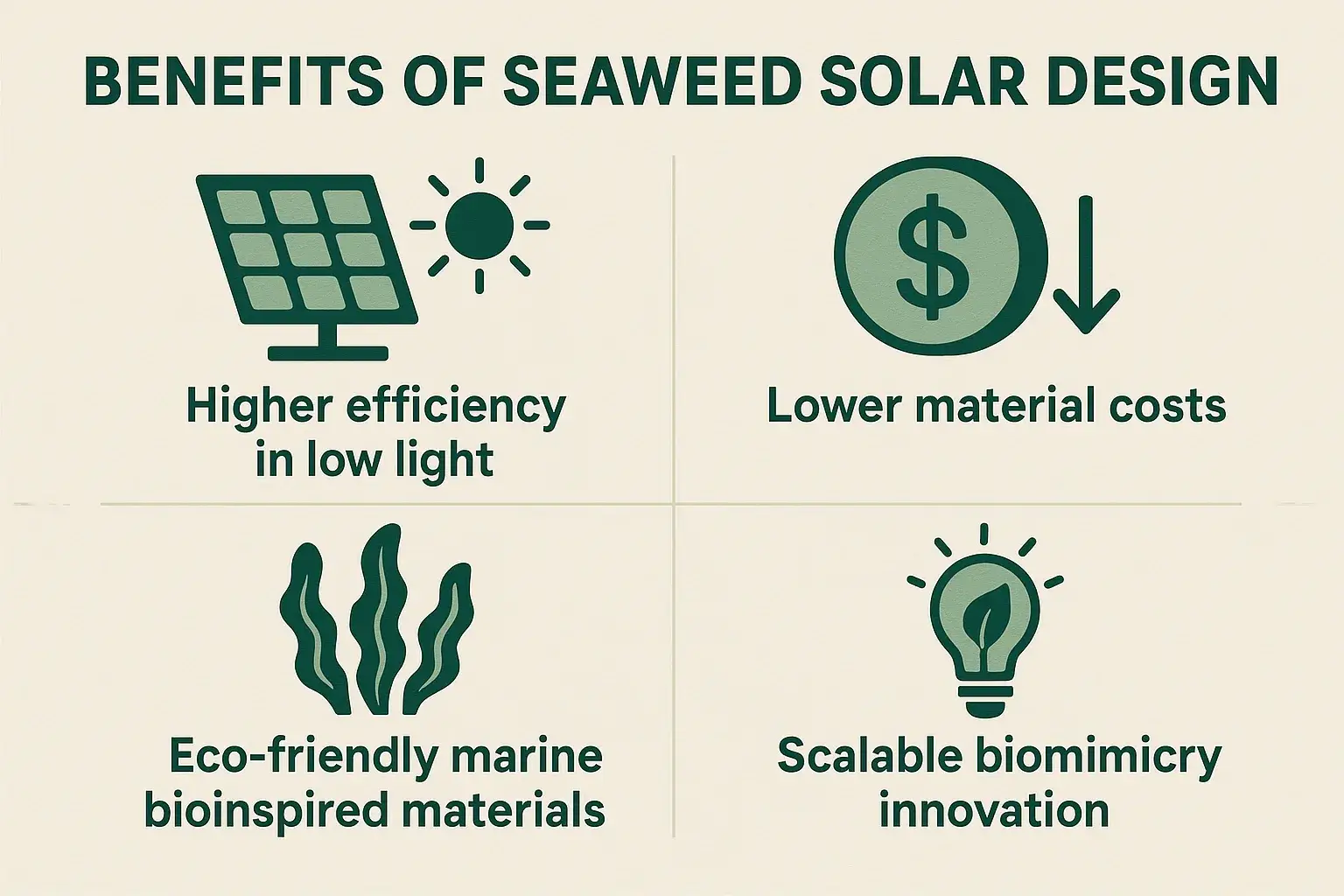
- Higher efficiency in diffuse light: seaweed solar design helps panels harvest light even in cloudy or shaded environments.
- Lower cost materials: using algae-inspired dyes, biopolymers, or abundant compounds can reduce dependency on rare metals.
- Sustainability: marine bioinspired materials are often biodegradable, renewable, or less environmentally damaging.
Challenges:
- Durability: biological or biohybrid materials must resist weathering, moisture, UV exposure.
- Scalability: manufacturing nanostructures or graded index layers at scale can be complex.
- Cost vs. performance trade-offs: achieving high efficiency while keeping production cost low remains difficult.
How Researchers Are Testing Seaweed Solar Design
Several labs and companies are already experimenting with seaweed solar design:
- Using seaweed pigments like chlorophyll derivatives to make organic solar cell dyes.
- Developing transparent coatings with micro-lenses or ridges that scatter light to maximize internal reflection.
- Simulating seaweed fracture networks to distribute light in multi-junction solar cells.
Embracing Seaweed Solar Design for the Future
Seaweed solar design offers a compelling path forward in renewable energy. By capturing the light-absorbing strategies and light-scattering surfaces found in seaweed cell structures, solar technology can achieve greater efficiency, lower cost, and improved sustainability. As biomimicry solar panels evolve, the principles of seaweed solar design may become central to next-gen, algae-inspired solar technology that truly scales. Embracing seaweed solar design could redefine how we power the planet—efficiently, affordably, and greenly.
See our earlier coverage on how technology and AI is improving heart health – Breakthrough Drug and AI Tools Revolutionize Heart Care for Better Lives
Questions & Answers
Q: What is seaweed solar design?
A: Seaweed solar design is an approach that takes inspiration from the structure and function of seaweed—specifically light-absorbing strategies and light-scattering surfaces—to improve solar panel materials and efficiency.
Q: How do light-scattering surfaces help solar panels?
A: Light-scattering surfaces extend the path of incoming light within the panel, reducing reflection losses, increasing photon absorption, and boosting efficiency—especially under diffuse or low-light conditions.
Q: Are seaweed-derived materials durable enough for solar panels?
A: Researchers are developing biocomposites, stabilised pigments, and protective coatings to ensure durability. Challenges remain, especially in exposure to moisture, UV radiation, and temperature shifts.
Q: Can seaweed solar design reduce the cost of solar power?
A: Yes. By using abundantly available marine bioinspired materials and simplifying manufacturing through structural mimicry, production costs can be lowered while maintaining or improving energy yield.
| Source | Link |
|---|---|
| Study on kelp-inspired microchannels improving solar absorption | https://www.nature.com/articles/s41565-025-01456 |
| Research on algal pigments in organic solar cells | https://www.sciencedirect.com/science/article/pii/S2211285525001234 |
| Review on graded refractive index coatings for photovoltaics | https://www.sciencedirect.com/science/article/pii/S0927025624007890 |
| Overview of biomimicry strategies in solar technology | https://www.frontiersin.org/articles/10.3389/fenrg.2025.00456 |