

How AI is rewriting the writing world
AI writers are rapidly transforming the way stories, reports, and even novels are produced. Once a distant concept, they’re now part of newsroom workflows, marketing teams, and even publishing houses. This rise has sparked a fierce debate: is AI a threat to writers, or is it simply the next great tool to enhance creativity?
In some corners of the industry, AI has already replaced people. In others, it has become an invisible assistant — helping humans write faster, smarter, and with fewer barriers. The truth lies somewhere in between: a world where writers who embrace AI thrive, while those who ignore it risk being left behind.


Where AI has already replaced writers
The newsroom’s new assistant
In journalism, AI systems now churn out brief financial updates, sports recaps, and weather summaries — the kind of routine pieces once handled by junior reporters. These programs can digest raw data, spot trends, and publish faster than any human. Yet even the best of them struggle to match the empathy and investigative instincts of a real journalist.
The silent workhorse behind content farms
On the lower end of the writing spectrum, AI has reshaped content mills and SEO farms. Entire sites now operate with minimal human input, relying on AI models to produce hundreds of short blog posts daily. The result is efficiency — but also a flood of generic, soulless content that leaves readers wanting more.
Product descriptions and catalogues
E-commerce is another industry quietly transformed. Thousands of product listings, once written line by line by copywriters, are now generated automatically. The text is clean, functional, and fast — yet it lacks the subtle persuasion that a skilled human can bring.
Academia and research writing
Even in academia, AI is making its mark. Scholars use AI tools to polish grammar, summarise findings, or simplify complex ideas for global audiences. Here, AI doesn’t replace researchers — it simply helps their words shine brighter.
Where AI could replace writers next
The potential for automation stretches far beyond what’s already visible.
- Creative fiction: Formulaic genre fiction — like romance or thrillers — is becoming a testing ground for AI-generated novels.
- Advertising copy: Brands are experimenting with AI to draft ad slogans, email subject lines, and A/B-tested campaigns.
- Social media management: AI can generate and schedule hundreds of short posts in minutes, blurring the line between human tone and machine precision.
- Scriptwriting and entertainment: Early tools are now creating plot outlines and dialogue suggestions for filmmakers and YouTubers alike.
- Grant and proposal writing: AI can help structure and draft lengthy documents, although credibility still demands a human signature.
The takeaway? AI doesn’t just threaten low-level content creation — it’s quietly creeping toward creative territory once thought untouchable.
How AI writers are boosting productivity
While fear dominates much of the conversation, there’s another side to this story — one of empowerment. Writers who learn to collaborate with AI often discover a remarkable boost in productivity and creativity.
AI can:
- Speed up production, completing first drafts in minutes rather than hours.
- Break through creative blocks, suggesting angles, outlines, and phrases that might otherwise take days to find.
- Ensure consistency, helping teams maintain tone and quality across hundreds of pages.
- Assist non-native speakers, refining language and clarity.
- Teach by example, showing new writers how to structure persuasive content.
For freelancers, marketers, and journalists, AI isn’t just a competitor — it’s a co-writer, capable of turning pressure into progress.
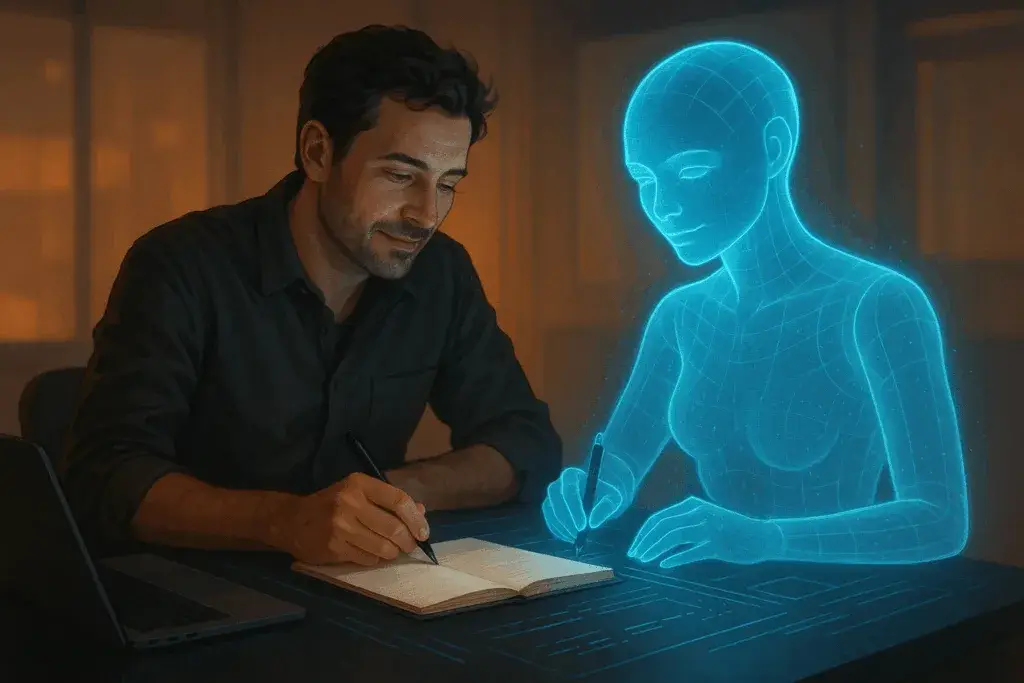
The pros and cons of AI writers
| Pros | Cons |
|---|---|
| Accelerates productivity and output | Can produce bland, formulaic text |
| Helps overcome writer’s block | Needs careful human editing |
| Maintains consistent tone | May lack emotional nuance or creativity |
| Improves accessibility for all writers | Risk of plagiarism or factual error |
| Reduces costs for businesses | Could lower pay rates for human writers |
The reality is nuanced. AI can make writing faster and more consistent, but not necessarily better. When used carelessly, it can strip away the unique rhythm and humanity that makes great writing memorable.
The impact across writing industries
Fiction and storytelling
Creative writing is where humans still reign supreme. While AI can produce structured stories, it struggles with heart, subtext, and the unpredictable sparks of inspiration that define great literature. Readers crave emotion — something no algorithm has mastered.
Journalism and media
In newsrooms, AI handles the “when” and “what,” but humans still uncover the “why.” Investigative journalism, commentary, and narrative storytelling remain deeply human crafts that depend on judgment and trust.
Marketing and copywriting
This is the most AI-friendly field. From product descriptions to ad copy, AI tools help marketers experiment faster. Yet the best campaigns still rely on emotional intelligence — knowing what truly moves a reader or buyer.
Technical and legal writing
AI can summarise laws, instructions, or research — but small errors in such fields can have huge consequences. Here, AI works best as a co-pilot, not the pilot.
Academic and scientific work
Researchers now rely on AI to polish and summarise their work, saving hours on editing. Still, it cannot design experiments or interpret results — the essence of research remains human.
How writers can adapt and stay relevant
- Develop your voice. The one thing AI can’t fake is authenticity.
- Become an editor, not a competitor. Use AI to produce drafts, then refine with human nuance.
- Specialise deeply. Experts with real-world knowledge will always outrank generic AI output.
- Embrace technology. Learn prompting, editing, and AI integration tools.
- Sell creativity, not words. Strategy, storytelling, and emotion can’t be automated.
The most successful writers of tomorrow won’t reject AI — they’ll master it.
Partnering with the machine
AI writers are neither pure threat nor pure salvation. They’ve already replaced humans in routine, repetitive writing — but they’ve also empowered thousands of professionals to work smarter and faster. The danger isn’t AI itself; it’s complacency.
Writers who cling to old habits may struggle. Those who embrace the tools, learn their limits, and blend creativity with technology will define the next era of storytelling. In the end, AI writers aren’t the enemy of creativity — they’re the catalyst forcing us to rediscover what truly makes writing human.
Read our other article – The Future of Work: How AI Transforms Every Industry
Questions & Answers
Q1. Is AI a threat to writers’ jobs?
Yes, especially for repetitive tasks. But human creativity, empathy, and storytelling still hold unique value.
Q2. Can AI write novels or poetry?
It can imitate style and structure, but not human emotion or experience. True artistry remains human.
Q3. How can writers benefit from AI?
Writers can use AI for idea generation, research, drafting, and editing — freeing time for deeper creative work.
Q4. Will AI reduce demand for writers?
It may reduce demand for basic copywriting but increase opportunities for editors, strategists, and creative directors.
| Source | Description | Link |
|---|---|---|
| Siege Media – “50 AI Writing Statistics 2025” | Key data on AI adoption, productivity, and how writing industries are evolving with automation. | https://www.siegemedia.com/strategy/ai-writing-statistics |
| Nielsen Norman Group (NNGroup) – AI Tools Improve Employee Productivity by 66% | Authoritative research showing measurable productivity gains when writers use AI tools. | https://www.nngroup.com/articles/ai-tools-productivity-gains/ |
| Denver Post Media – “Should You Use AI to Write Content?” | Objective breakdown of the advantages, risks, and ethical challenges of AI-generated writing. | https://www.denverpostmedia.com/2025/02/10/should-you-use-ai-to-write-content-pros-and-cons/ |
| FoxPrint Editorial – “Will AI Replace Writers? It Already Is.” | Real-world examples showing how AI has already begun replacing human writers in publishing and marketing. | https://foxprinteditorial.com/2023/05/11/will-ai-replace-writers-it-already-is/ |
| Wikipedia – “Content Farm” | Background on how large-scale content production shifted to AI automation and SEO-driven models. | https://en.wikipedia.org/wiki/Content_farm |