

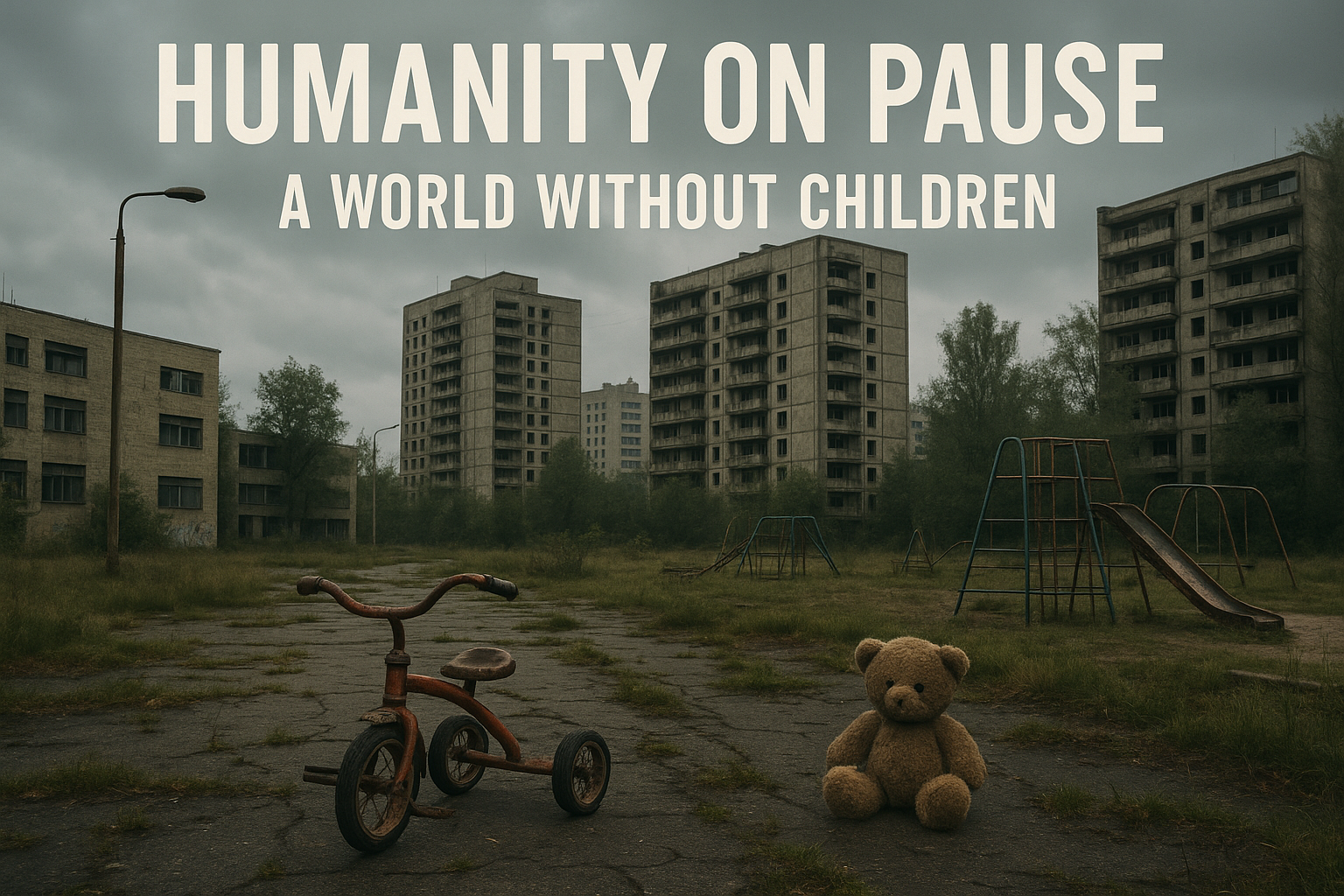
The idea that humanity could one day stop having children may sound like a science-fiction scenario, but in many developed nations, it feels closer to reality than ever before. Declining birth rates across countries such as the United States, Japan, and South Korea have triggered urgent warnings about the long-term survival of societies as we know them. If global fertility were to fall to near zero, civilization would face profound and irreversible consequences—from economic stagnation to social breakdown.
A Crisis Already Unfolding
Fertility rates worldwide have been steadily declining for decades. The United Nations projects that by 2050, over two-thirds of nations will have fertility levels below the “replacement rate” of 2.1 children per woman, the level needed to maintain a stable population. In countries like South Korea, the situation is even more dire: its fertility rate recently dropped to just 0.7—the lowest in recorded history.


This demographic decline means fewer young people are entering the workforce, while populations age rapidly. The balance between working adults and retirees is shifting in a way that threatens the very foundations of economies and welfare systems.
The Economic Domino Effect
If humanity stopped having children altogether, the global economy would quickly spiral into crisis. The workforce would shrink year by year, eroding productivity, slowing innovation, and collapsing industries dependent on younger generations.
Consumer demand would nosedive as fewer families purchased homes, cars, clothing, or technology. Even industries like healthcare, traditionally considered resilient, would struggle to function without new workers entering the system. Governments would face collapsing tax revenues while simultaneously paying out record amounts in pensions, healthcare, and social services to an elderly population.
In short, the engines of economic growth would stall, leaving future generations with a shrinking, unsustainable system.
Social Structures Under Strain
Economics is just one side of the coin. Societies built on the assumption of generational renewal would see their foundations crumble. Without younger generations, schools would shutter, neighborhoods would empty, and entire cities could turn into ghost towns.
Social isolation would become a defining feature of daily life. With few or no children, cultural traditions tied to family life—festivals, holidays, and rites of passage—would fade into obscurity. Intergenerational bonds, which anchor much of human community, would vanish.
Moreover, with fewer young people to care for aging relatives, elderly individuals could face increasing loneliness and neglect. Nations already struggling with rising mental-health crises would likely see those challenges multiply.
Geopolitical Shifts
Global demographics are directly tied to geopolitics. Nations with young and growing populations often enjoy greater military and economic strength, while aging nations struggle to project power.
If fertility rates collapsed across the board, geopolitical tensions could rise as nations competed for shrinking pools of young talent, skilled workers, and immigrants. Countries that fail to adapt could lose influence rapidly on the world stage, giving way to those that manage to balance innovation and demographic renewal.
Possible Solutions
While a world without children would be catastrophic, many experts argue that solutions exist to slow or reverse demographic decline. Policies that support parents—such as affordable childcare, paid parental leave, and housing subsidies—have helped stabilize birth rates in countries like France and Sweden.
Immigration also plays a vital role. By welcoming younger populations from regions where birth rates remain higher, nations can mitigate demographic collapse. However, this requires political will and cultural openness, both of which are under pressure in many countries today.
Technological innovations may also soften the blow. Advances in automation and artificial intelligence could offset labor shortages, while breakthroughs in longevity research might help extend working years. Still, technology cannot fully replace the role of new generations in driving creativity, innovation, and cultural continuity.
A Stark Reminder
The theoretical scenario of humanity ceasing to have children is unlikely to occur completely—but the accelerating decline in fertility rates is real, measurable, and urgent. The future of civilization depends on addressing this demographic threat before it reaches a point of no return.
At its heart, this issue is not just about numbers and statistics. It is about the continuity of human stories, traditions, and relationships. Children are not only future workers or taxpayers—they are the carriers of hope, creativity, and progress. Without them, the world would become a quieter, lonelier, and ultimately unsustainable place.
| Source | Link |
|---|
| The Atlantic – Global Decline in Birth Rates | Read here |
| Salzburg Global – South Korea’s Fertility Warning | Read here |
| The Guardian – Europe’s Population Crisis | Read here |
| Times of India – Elon Musk on Birth-Rate Collapse | Read here |
| Financial Times – School Closures in Greece | Read here |
| The Guardian – Fertility Decline in UK | Read here |
| Daily Beast – U.S. Population Decline Forecast | Read here |
| Financial Times – Global Population Trends | Read here |
| Le Monde – Aging Societies in Crisis | Read here |
| Wall Street Journal – The Depopulation Bomb | Read here |
| The Guardian – Global Birthrates Dropping | Read here |