

A Historic Turning Point in Global Child Health
The latest global health findings confirm a remarkable achievement: child mortality decline has reached its lowest point in recorded history. Over the past decade, a combination of expanded vaccine access, stronger health systems and targeted public-health campaigns has driven a transformation in how nations protect their youngest populations. During this period of rapid global health progress, child survival rates have improved dramatically, showcasing the impact of both international collaboration and domestic healthcare investment. This achievement marks one of the most significant victories in modern public health.
The Global Data Behind the Historic Drop
Recent global data shows a sustained and measurable reduction in deaths among children under the age of five. Public health agencies report that mortality rates have fallen across nearly every world region, even in areas previously identified as high-risk. While disparities remain, the universal trend has been unmistakably positive.


Several factors underpin this breakthrough:
- Widespread immunisation campaigns, especially for measles, polio, pneumococcal disease and rotavirus.
- Expanded access to frontline healthcare, including rural clinics, mobile units and community health workers.
- Better maternal healthcare, improving infant outcomes from birth.
- Earlier diagnosis and treatment of common childhood illnesses such as pneumonia, malaria and diarrhoea.
These developments reflect a combined strategy involving governments, local health ministries, NGOs and global institutions working toward the shared goal of reducing preventable deaths.
Vaccines: The Cornerstone of Child Survival
Vaccines have been at the centre of the worldwide child mortality decline. Immunisation programmes have reached historically high coverage levels, particularly in developing regions. The expansion of cold-chain systems, digital monitoring tools and micro-planning have reduced gaps in access.
Key vaccine-related milestones include:
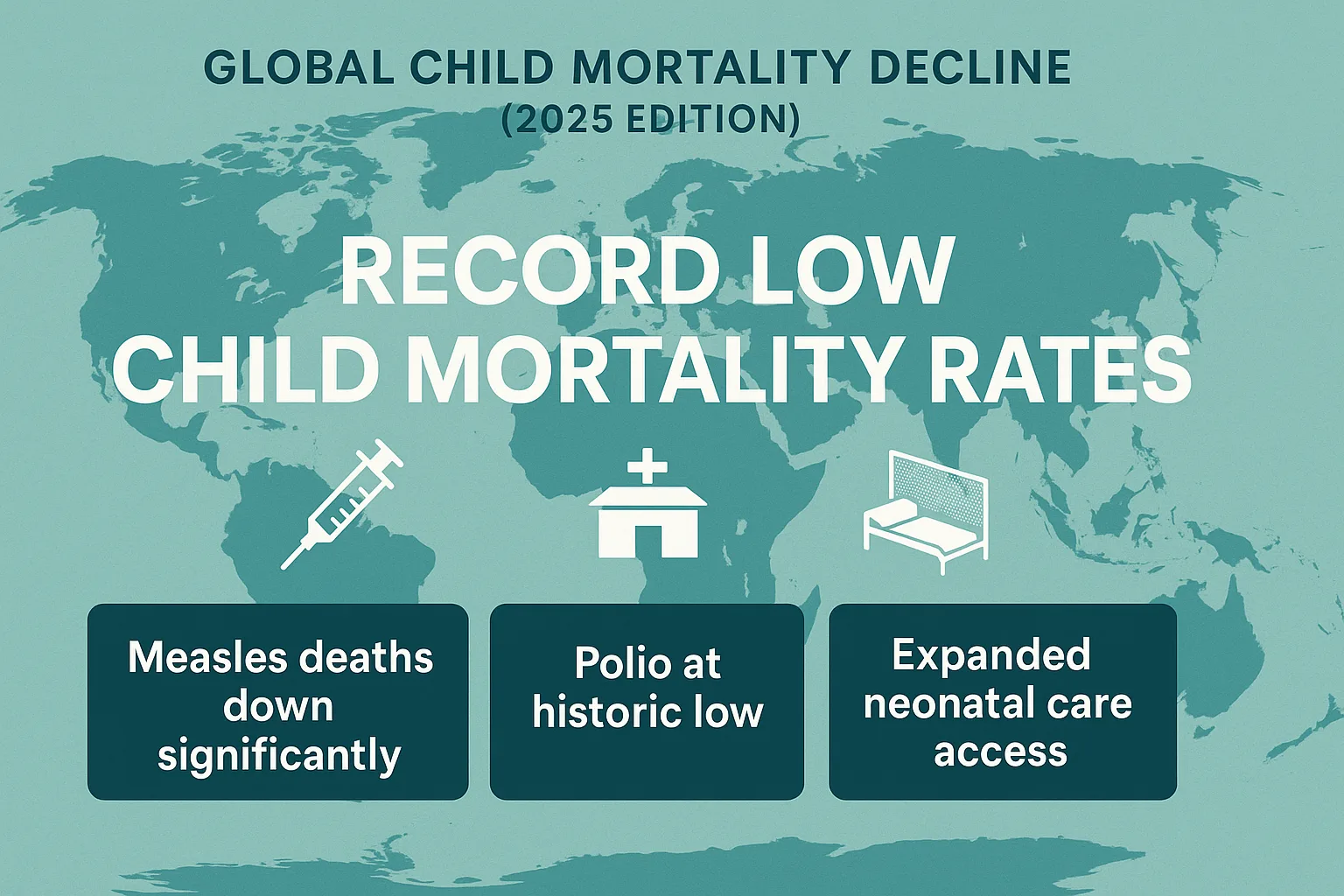
- Measles vaccinations preventing millions of deaths, especially in regions with historically weak healthcare systems.
- Polio cases at their lowest levels ever recorded, due to intensive eradication efforts.
- Pneumococcal and rotavirus vaccines sharply lowering fatal infections, diseases that once contributed heavily to infant mortality.
- New malaria vaccines deployed, marking a turning point in combating one of childhood’s deadliest diseases in Africa.
The scale and coordination of these initiatives have played a crucial role in the overall global health progress described in current reports.
Improved Healthcare Access and Investment
Beyond vaccines, better access to general healthcare has accelerated child survival rates. Many countries have increased investment in healthcare infrastructure, training and digital health systems. These improvements have enabled earlier diagnosis, quicker treatment and improved continuity of care.
Several impactful developments include:
- Expansion of rural clinics, reducing geographic barriers.
- Deployment of community health workers, bringing care directly to families.
- Modernisation of neonatal units, improving survival rates for premature births.
- National health-insurance schemes offering families more affordable care.
These system-wide advances contribute significantly to the child mortality decline recorded globally.
Regional Success Stories
Although the trend is global, certain regions stand out for exceptional progress:
- South Asia: Rapid improvements in immunisation, sanitation and maternal care have led to steep reductions in child mortality.
- Sub-Saharan Africa: While challenges persist, increasing vaccine coverage and malaria prevention programs have driven measurable progress.
- Latin America: Long-term investment in public health infrastructure continues to strengthen child survival outcomes across multiple countries.
These regional gains highlight how strategic investment can produce sustained improvements even in areas with varied economic capacities.

Remaining Gaps and Challenges
Despite the impressive progress, significant challenges remain:
- In some conflict-affected regions, healthcare access is limited or disrupted.
- Economic inequality continues to impact health outcomes for marginalised communities.
- Vaccine misinformation and hesitancy have created pockets of low immunisation.
Addressing these issues is essential to maintain the global child mortality decline and extend it even further.
Why This Milestone Matters for the Future
The global achievement in child mortality decline marks one of humanity’s most meaningful public-health victories. Driven by vaccines, expanded healthcare access and collaborative global health efforts, this milestone represents decades of sustained investment and innovation. While challenges persist, the continuing improvements in child survival rates highlight what is possible when nations prioritise equitable healthcare. The world’s youngest populations are now safer than ever before — and further progress remains within reach.
Read our other article – California’s Food Revolution: Schools Ban Ultra-Processed Meals
Questions & Answers
Q1: What is the main reason for the global child mortality decline?
The primary drivers are vaccines, improved healthcare access and early treatment of preventable diseases.
Q2: Which diseases have seen the largest reductions in child deaths?
Measles, pneumonia, malaria and rotavirus infections have seen major mortality reductions due to immunisation and improved care.
Q3: Are all world regions experiencing child mortality improvements?
Most regions show significant progress, though disparities remain in conflict zones and areas with limited healthcare infrastructure.
Q4: How have global health investments contributed to the decline?
Funding has expanded clinics, trained health workers, modernised neonatal care and improved vaccine supply systems.
| Source Name | Link |
|---|---|
| UNICEF — Under-Five Mortality Rate (Child Survival) | https://data.unicef.org/topic/child-survival/under-five-mortality/ (UNICEF DATA) |
| WHO — Child Mortality & Causes of Death | https://www.who.int/data/gho/data/themes/topics/child-mortality-and-causes-of-death (World Health Organization) |
| World Bank — Under-5 Mortality Rate (per 1,000 live births) | https://data.worldbank.org/indicator/SH.DYN.MORT (World Bank Data) |
| UNICEF — Levels & Trends in Child Mortality 2024 Report | https://data.unicef.org/resources/levels-and-trends-in-child-mortality-2024/ (UNICEF DATA) |